Monday, June 13, 2016

The Growth Mindset and Learning Mandarin

As I've mentioned earlier in this blog, somehow learning Mandarin in America became tantamount to accessing a luxury or privilege in education. Or worse, yet, it became some kind of signal that a student was gifted or especially talented and intelligent.

Look, learning the Chinese language is hard. Whether it is Mandarin, Cantonese, Shanghainese, Fujianese, or any of the other dialects. But only if you are not a native speaker of these languages, and especially if you are a native speaker of a phonetic language. Tonal homonyms is one thing, the ideogrammatic writing is yet another. There are a lot of built-in challenges that have nothing to do with privilege or luxury or even intelligence.

As Carol Dweck, heralded researcher and thought leader in educational psychology at Stanford, has been advocating, a growth mindset can make all the difference. Her book Mindset: The New Psychology of Success has inspired educators, parents, business and civic leaders to change the way we think about human development in every corner of our lives, from how we run our schools to how business leaders manage, to cultivating fulfilling relationships.
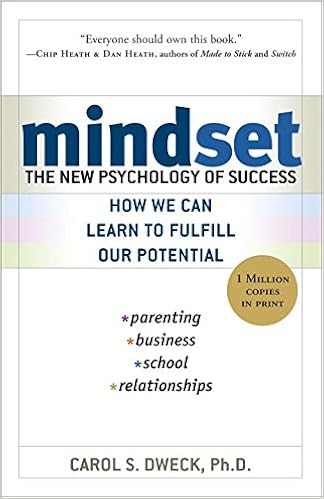


Her work counters the praise-ridden self-esteem movement and shows that tackling something challenging helps the brain to grow. People who adapt to this "growth mindset" - where they want to take on challenges and do not expect the immediate gratification of instant success - are more likely to find long term happiness and success.

The opposite of this Growth Mindset is what she calls the "fixed mindset." People with a fixed mindset believe intelligence is inborn, that one's superiority is evident and manifest without much effort. People with a fixed mindset have a hard time recovering from failure.

I'd like to see more parents apply this Growth Mindset to bilingual education for their kids. It's not easy to learn 2 languages (or even more) while you're a kid. Success takes hard work, and enduring difficulties which means not always feeling good. When your child is feeling discouraged in the classroom or in the face of the entire daunting challenge, Dweck is urging you to guide your child through these feelings - Help your child take on a growth mindset to believe that through repeated effort, s/he can overcome these feelings of discouragement. Eventually, they will transform into feelings of gratification. But only after slogging through the columns of repeated character writing.

I hope Mandarin teachers take this message to heart and stop teaching to low-to-mediocre standards. Tell American parents the truth. Expect more from your students and don't take back down. So what if many of your students are getting B's and C's? If you required your students to write one full page, then stick to that standard. If they only write half the amount on an essay, then let them know by giving them a lower grade. Then it is up to the parents and the students to work together and learn to acquire this growth mindset.

The irony in all this is that hard work and not being coddled is actually a natural aspect of the Chinese culture.

As Dweck writes in her book, "Many people with the fixed mindset think the world needs to change, not them. They feel entitled to something better..." Exactly. Herein lies the problem - Entitlement.

There's no entitlement in learning another language. Either you do it, or you don't, and you can use it, or you cannot. Being able to use that second language doesn't happen just because you showed up. Dweck's research has been unequivocal on this simple point: To achieve anything, you have to work for it. So take on a Growth Mindset, and get to work.

Sunday, June 12, 2016

"Equity and Access" in Education vs. Balancing Needs against Resources

There was a recent article in the NYTimes on China's efforts to redistribute access to the more competitive universities as a force combatting poverty:

China Tries to Redistribute Education to the Poor, Igniting Class Conflict
Students in Mianyang, China, did review work in May as they prepared for the national college entrance exam, known as the gaokao. The exam gives the admissions system a meritocratic sheen, but critics say it reinforces the divide between urban and rural students. CreditImaginechina, via Associated Press
BEIJING — Cheng Nan has spent years trying to ensure that her 16-year-old daughter gets into a college near their home in Nanjing, an affluent city in eastern China. She wakes her at 5:30 a.m. to study math and Chinese poetry and packs her schedule so tightly that she has only 20 days of summer vacation.
So when officials announced a plan to admit more students from impoverished regions and fewer from Nanjing to local universities, Ms. Cheng was furious. She joined more than 1,000 parents to protest outside government offices, chanting slogans like “Fairness in education!” and demanding a meeting with the provincial governor.
“Why should they eat from our bowls?” Ms. Cheng, 46, an art editor at a newspaper, said in an interview. “We are just as hard-working as other families.”

These battles are all too familiar in the U.S. While I believe these types of efforts and policies merit the respect and goodwill of the general public, it can also be a sign of lazy leadership.

While Mandarin Immersion programs have been getting off the ground here in the U.S., the "equity and access" discourse also took hold in their shaping. Battles broke out at mid-levels (and they continue) amongst parents and educators over who would shape the "access" to "successful" MI. And thusly, who would be the intended beneficiaries in terms of "equity."

I have long held the belief that as the limits of China's economic boom were reached, the interest in the U.S. to learn Mandarin would gradually wane. Americans simply underestimate the scale and complexity of China's own poverty. I, myself, would have never known had I not been able to accompany my father on many trips to China in the 1990's and given tours of efforts in those circles of engineers trying to tackle infrastructure development.

The millions-to-be-made motivation (seriously, how many times did I hear from parents in MI programs that their main aspiration for their kids learning Mandarin was to be able to make money in China?) would fade by the time my kid was in college or grad school, at least. Well, it happened a lot faster. Hehe.

China has its own problems, as this article can attest. The answers do not lie in lazy one-directional policies. For China to improve everyone's plight, there must be as much effort in pushing out talent and technologies, efficient and equitable systems, as there would be the pulling in of promising students from the outer provinces to the big cities. And while the leadership has stated aspirations of doing so, then both communication and comprehensive alignment of policies must be robust.

Access to education has never been completely fair. But could Ms. Cheng the art editor mom in this article be assisted in comprehending that reality in its full, concrete detail?

The battle is, in fact, over numbers in seats (sometimes phrased more crudely, butts-in-seats). As I've explained in this blog, MI programs in America needed the proper number of butts-in-seats that created balance, in order to meet targets for effectiveness. Two-way programs needed the right ratios of EO kids to MP kids (EO=English-Only, MP=Mandarin-Proficient). One-way programs needed to accept that volume was directly proportional to the effectiveness of one, single, lonely MP teacher. And in all cases, parents' own abilities, expectations and implemented supports were directly correlational to results.

China's equity and access problems face the same challenges. If the universities in Beijing, Shanghai and Nanjing accept too many students from the outer problems, then the communities and student-support systems would be overwhelmed by the needs of these students. That is not at all saying that these students are not worthy. But every student, regardless of background, arrives with their own mix of social, emotional and academic needs that require the right mix of support in order to be optimally successful.

Students from these high performing universities are naturally supported by their families who are more likely to be local, than not. While one is struggling through demanding studies, the comforts of home are not far away. This contributes to their "success." A student from a far-flung province doesn't benefit from that easy, accessible comfort. The government would need to provide private, on-demand jet service in order to make the situation more equitable.

"Successful" language education is just like all of education, itself. To be effective, there are myriad social, emotional and academic supports that contribute to success. Many of those supports for effective language education have been largely invisible to Americans. Hence my effort in starting this blog...

In America, the talk is also about access to the schools, as if education lived in the walls of the school buildings, themselves. Education lives in people. If you take all the people out, just like you would gut a house to its basic frame, and nothing else, do you still have a functioning house?

When you overwhelm a school community with needs and not enough resources to meet those needs, people who have resources and can leave will leave, thereby leaving only the high needs. A dynamic community shapes a school. Authentic engagement is necessary. And leadership that is not lazy or dishonest about the realities we face.

I have left 2 high-needs MI schools at this point - one public, one private. In both cases, the balance of needs vs. resources to meet those needs tipped far out of balance to warrant staying. And worse, still, in both cases, the leadership of these schools was lazy. Too lazy to acknowledge the reality of the imbalance of Needs vs. Resources creating the difficulties.

Wednesday, June 8, 2016

Simplified vs. Traditional, revisited

Now that my child has spent one year, her 6th grade year, immersed in learning Traditional, rather than Simplified, I wanted to post an update... It was not a difficult transition. She was old enough to understand what was happening and ambitious enough to want to take on the challenge.

When we started MI in kindergarten, I had no idea what Simplified was all about. By the time we made it to 4th grade, my own brain could no longer make out Traditional characters.

But as one advances, many of the Simplified and Traditional characters are, indeed, one and the same - i.e., there is no difference in their written form. I don't know when or why... but it seems like often enough that progressing to Traditional does matter at some point in your kid's Chinese literacy development.

My child has transitioned this past school year, to the point of not necessarily knowing how to read Simplified characters at first glance. So we'll spend the summer reading Simplified texts with a converter table from the back of the textbook. Both the Hanban and Jinan University textbooks have this in the back of each. So we'll just rip it out and put it next to her while she reads.

Monday, May 9, 2016

Raising a Bilingual Child, by Barbara Zurer Pearson


Oh, Barbara, if only I had discovered your book when it was first published in 2008! What grief I would have been spared!

Parents, if you are serious about achieving bilingual-ism, then read her book.

Zurer-Pearson covers so many essentials, from the research models to the variations in goals. She highlights parent households of same-language or different languages, bilingual and trilingual families, unevenly multi-linguals, and even issues with heritage bilinguals.


My own success has mirrored the advice she offers, here. So if you are just starting out, this book is worth sifting through!

The model... Did they break the model, or are they being faithful to it?

Now that my child's Mandarin proficiency is humming along at a pace and quality I find reasonable, I've got some time to revisit these posts...

To break up some of the key ideas and highlight them into shorter posts, make the ideas more searchable.

The model matters. The research exists. Your school should be working with a model that has been found to be successful.

So what is your school's supposed model? Ask your teachers, ask your principal. Find out if they even know...

Two-Way Language Immersion is supposed to have no more than 50% of the kids from English-Only backgrounds. (I'm saying English-Only more boldly because I'm writing for American audiences, where we are still very far behind the notion of bilingual and bi-literate proficiency overall.)

Take a look at your child's classroom. If more than half the kids are from a language that is NOT the desired language you want your kid to learn (in this blog's case, Mandarin), then you are in trouble.

There is no getting around it. I still hear parents making all kinds of excuses. But... if... and we do all this extra... besides, our goals are different...we just want some language, not too much...

Yes, I've heard it all before. Forget it. What you will find is that EVERYTHING collapses. Academics, cognitive development... If the model is broken, the model is broken. Things won't "work" the way they are supposed to work.